
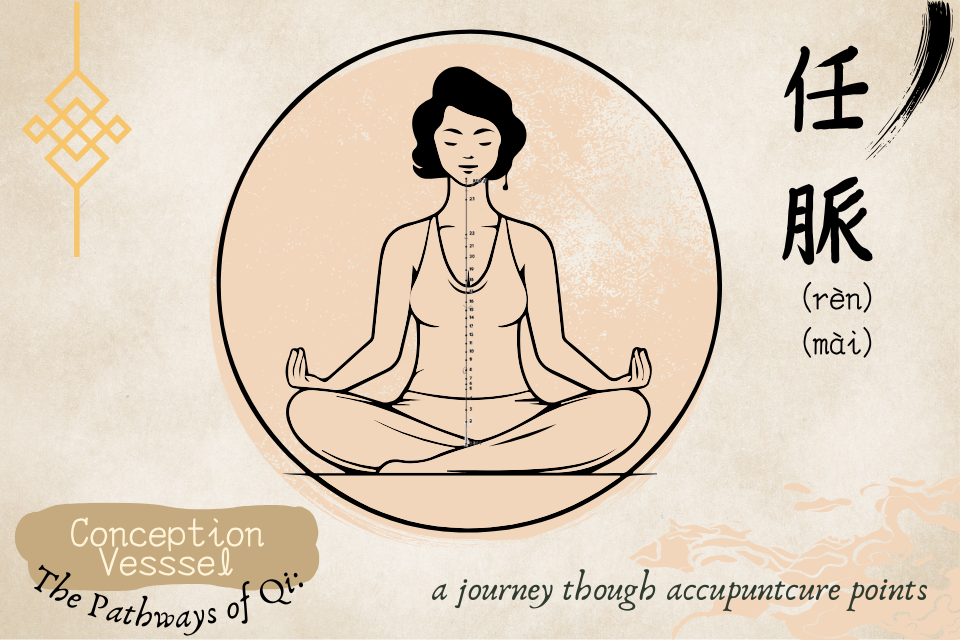
The pathways of Qi: Ren Mai — CV9 Shuǐfēn 水分
Although the Conception Vessel is well known, it is of great importance to begin by understanding what this main channel itself represents:
When we know the meaning of the vessel, our grasp of each point becomes deeper and more precise.
Ren Mai is not simply a line across the body: it is the Sea of Yin itself — a current of nourishment, receptivity, and creation.
When we know the essence of the channel, the meaning of each point deepens: its qualities are not random but shaped by the vessel it belongs to. Ren Mai is Yin, every point along its course is touched by Yin’s color, even when certain points lean toward Yang expression. It is as if the whole river dyes each stone it carries with its waters. This underlying nature colors, unifies the pathway, allowing us to appreciate each point not only in isolation but as part of a larger current of meaning.
任脈 (Rèn Mài) — The Conception Vessel
任 (Rèn): The character 任 signifies “to bear, to carry responsibility, to entrust.” It combines the person radical (亻) with the phonetic 壬, symbolizing the body’s duty to nourish and sustain. In the Conception Vessel, it evokes the profound task of carrying life, whether in the womb, in the blood, or in the hidden spark of ideas yet to be born.
脈 (Mài): The character 脈 means “vessel, meridian, pulse.” It combines 月 (flesh) with 永 (eternal flow), representing circulation that never ceases, the endless river of life within us.
Together — 任脈 (Rèn Mài): The Conception Vessel is called the “Sea of Yin,” the channel that governs fertility, creation, and nourishment. More than a pathway, it is a living metaphor for the body’s capacity to hold, sustain, and bring forth new beginnings.
Spiritual Symbolism: The Ren Mai embodies Yin — receptive, grounding, life-giving. It stabilizes Yang by containing it and is most influential in reproduction and childbirth. It is the vessel of beginnings, carrying the possibility of renewal in every cycle.
CV9 Shuǐfēn — 水分 (“Water Division”)
Name & Imagery
CV9, Shuifen — “Water Division” or “Water Separation” — is the point where the body’s internal tides are regulated. If CV8 (Shenque) is the gate of origin, CV9 is the regulator of flow. Situated just above the navel, Shuifen is where the sea of fluids is divided — what is pure rises, what is turbid descends. It is the subtle minister of the body’s waters, directing balance between upper and lower, inner and outer.
In classical texts, Shuifen is described as the place where “water separates into clear and turbid,” a locus of transformation and discernment. Symbolically, this point represents the wisdom of the body to distinguish — not through intellect but through nature — what must ascend and what must be released.
Water, in Chinese medicine, is both physical and spiritual: it reflects, carries memory, and adapts. Shuifen, as its divider, ensures that water nourishes rather than overwhelms. It is the quiet engineer of balance between containment and movement.
Location
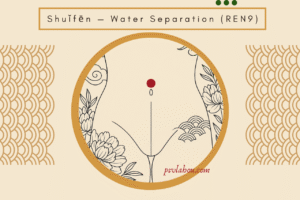
CV9 is located 1 cun above the center of the umbilicus, on the midline of the abdomen.
Because of its proximity to vital organs and its role in regulating fluids, it is often treated gently —
through needling with care, or through moxibustion and tonifying techniques aimed at harmonizing the middle burner.
Classical Functions
In the classics, Shuifen is known for its ability to regulate water passages and transform dampness. It drains edema, supports the Spleen’s function of transformation and transportation, and harmonizes the Stomach and Intestines.
When the waters of the body overflow — as in edema, ascites, or bloating — Shuifen acts as the sluice gate, restoring proper direction to the body’s inner rivers.
In short:
Regulates water passages and transforms dampness
Promotes urination and reduces edema or abdominal swelling
Harmonizes the Stomach and Intestines
Supports the Spleen and assists fluid metabolism
Modern Context
Today, CV9 is valued for its balancing effect on fluid metabolism, digestion, and abdominal distension. In clinical practice, it is often used for edema, ascites, or water retention due to Spleen and Kidney deficiency.
Moxibustion or gentle needling can stimulate the body’s natural ability to manage fluids and harmonize digestion. In somatic and qigong work, awareness at CV9 is said to awaken the mid-abdomen intelligence — the discerning aspect of the body that “knows what to keep and what to let go.”
Shuifen is thus not only a regulator of physical water but of emotional and energetic flow: it helps release stagnation, over-attachment, or emotional swelling, restoring clarity and calm.
Symbolism and Cross-Cultural Echoes
Water is the symbol of life, adaptability, and emotion across cultures. In Chinese cosmology, the division of water at Shuifen reflects the separation of Heaven and Earth — a creative act of ordering chaos into balance. In Indian traditions, the area resonates with the Manipūra Chakra, where transformation of nourishment and personal power occurs; here, too, water and fire meet.
In Western thought, water has long symbolized the unconscious and emotion — and the act of “dividing the waters” recalls Genesis: the differentiation that makes life possible. Shuifen embodies this same principle: balance born of distinction, flow arising from form.
Point Combinations
In classical prescriptions, CV9 is often combined with:
SP9 (Yinlingquan) and ST28 (Shuidao) to promote urination and reduce damp accumulation.
CV3 (Zhongji) and CV4 (Guanyuan) for regulating lower Jiao water disorders.
ST36 (Zusanli) to strengthen the Spleen and harmonize digestion.
Symbolically, these combinations link Shuifen’s role as the “water divider” with points that either drain, transform, or nourish — maintaining the body’s rivers in right proportion.
Gentle Practice for Self-Care
To honor Shuifen, rest your palms gently above the navel and breathe deeply into the abdomen. Imagine a calm lake beneath your hands — still, reflective, discerning. With each breath, feel the body balancing inner tides: warmth descending, clarity ascending.
A gentle circular massage around the navel area, moving clockwise, can aid digestion and relieve water retention. Warm compresses or mild moxa over CV9 can soothe the Spleen and strengthen the body’s center against dampness or swelling.
Reflection
Where in my life do I need to let the waters separate — to clarify, to release, to flow freely again?
Do I allow stillness enough for the clear to rise and the turbid to settle?
Shuifen invites us to trust the body’s quiet intelligence — to know, without effort, the art of balance between holding and letting go.
References
GB/T 12346-2021. Nomenclature and Location of Acupoints. Standardization Administration of China.
Huangdi Neijing (Yellow Emperor’s Inner Classic). c. 2nd century BCE.
Wiseman, N., & Ellis, A. Fundamentals of Chinese Medicine. Paradigm Publications, 1995.
Kaptchuk, T. J. The Web That Has No Weaver: Understanding Chinese Medicine. McGraw-Hill, 2000.
Classical Chinese Medicine texts, Nan Jing, Ling Shu, Zhen Jiu Jia Yi Jing, and clinical commentaries on the Ren Mai pathway.
Panagiota Sophia Vlahou
Certified Beekeeper | Specializing in Traditional Beekeeping & Natural Wellness Methods
Trained in Traditional Acupuncture – Academy of Traditional & Chinese Medicine
Member of the Beekeepers’ Association of Attica-Greece
Disclaimer: This article is for educational and informational purposes only. It is not intended to diagnose, treat, cure, or prevent any disease, and it does not substitute professional medical advice. Always consult a qualified healthcare professional before making any changes to your diet, lifestyle, or health practices.


