
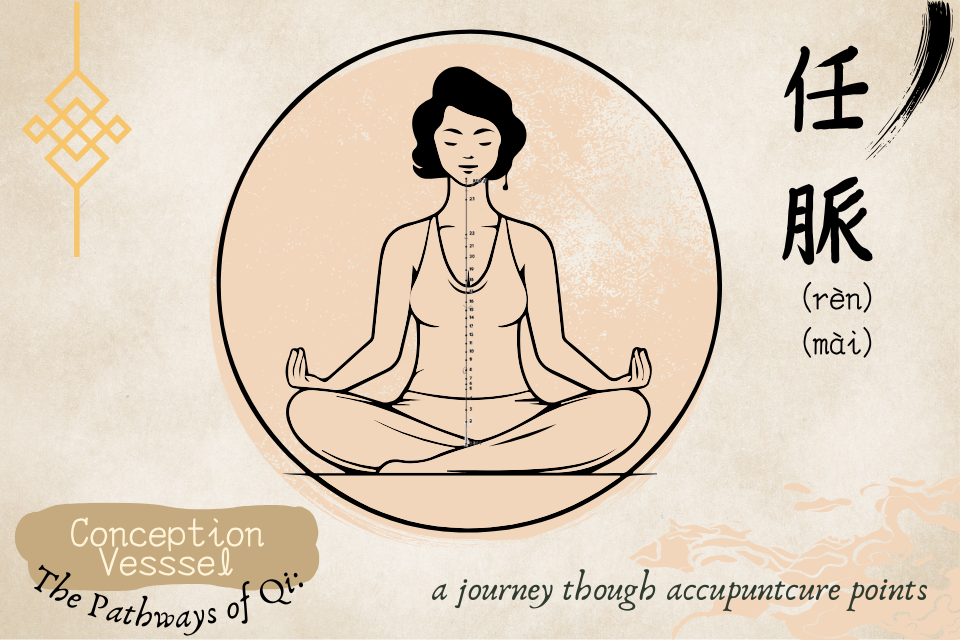
Although the Conception Vessel is well known, it is of great importance to begin by understanding what this main channel itself represents. When we know the meaning of the vessel, our grasp of each point becomes deeper and more precise. Ren Mai is not simply a line across the body: it is the Sea of Yin itself — a current of nourishment, receptivity, and creation. When we know the essence of the channel, the meaning of each point deepens: its qualities are not random but shaped by the vessel it belongs to. Ren Mai is Yin, every point along its course is touched by Yin’s color, even when certain points lean toward Yang expression. It is as if the whole river dyes each stone it carries with its waters. This underlying nature colors, unifies the pathway, allowing us to appreciate each point not only in isolation but as part of a larger current of meaning.
任脈 (Rèn Mài) — The Conception Vessel
任 (Rèn): The character 任 signifies "to bear, to carry responsibility, to entrust." It combines the person radical (亻) with the phonetic 壬, symbolizing the body's duty to nourish and sustain. In the Conception Vessel, it evokes the profound task of carrying life, whether in the womb, in the blood, or in the hidden spark of ideas yet to be born.
脈 (Mài): The character 脈 means "vessel, meridian, pulse." It combines 月 (flesh) with 永 (eternal flow), representing circulation that never ceases, the endless river of life within us.
Together — 任脈 (Rèn Mài): The Conception Vessel is called the "Sea of Yin," the channel that governs fertility, creation, and nourishment. More than a pathway, it is a living metaphor for the body's capacity to hold, sustain, and bring forth new beginnings.
Spiritual Symbolism: The Ren Mai embodies Yin — receptive, grounding, life-giving. It stabilizes Yang by containing it and is most influential in reproduction and childbirth. It is the vessel of beginnings, carrying the possibility of renewal in every cycle.
CV7 Yinjiao — 陰交 (Yin Intersection)
Name & Imagery
CV7, Yinjiao — “Yin Intersection,” is a meeting place of Yin forces, a convergence of waters within the lower abdomen. The image is of channels of Yin essence crossing and gathering in one node, strengthening the womb and the deep reservoir of vitality. Like streams that join to form a fertile riverbed, Yinjiao symbolizes union, nourishment, and the creative fertility that arises when Yin energies are harmonized.
Location
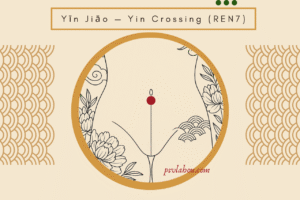
CV7 is located on the anterior midline of the lower abdomen, 1 cun below the umbilicus. This places it in the lower jiao, yet closer to the navel than CV5 or CV6, a liminal space where Yin gathers before rising to nourish the whole body. It bridges reproductive vitality and digestive fire, anchoring its role between nourishment and transformation.
Classical Functions
In the classical sources, CV7 is described as a point that nourishes Yin, regulates menstruation, and benefits the uterus. It supports fertility, moistens dryness, and eases abdominal fullness or pain. Its nature is restorative, bringing balance when Yin has been depleted.
In short:
Nourishes Yin and blood
Regulates menstruation and benefits the uterus
Harmonizes the lower abdomen
Modern Context
Today, CV7 is recognized in acupuncture and acupressure as a supportive point for gynecological health, fertility, and conditions of Yin deficiency. It is sometimes used in cases of irregular menstruation, infertility, or menopausal imbalance. Gentle moxibustion may warm and stabilize the lower abdomen, while mindful abdominal breathing over this area can awaken awareness of one’s creative center.
Symbolism and Cross-Cultural Echoes
Yinjiao resonates strongly with the Sacral Chakra (Svādhiṣṭhāna) in Indian tradition. Both are situated just below the navel and embody themes of creativity, sexuality, emotional flow, and reproduction. The water element defines them both: the sacral chakra as the river of pleasure and flow, Yinjiao as the intersection where Yin currents gather to nourish life. Daoist imagery sees this point as a wellspring where hidden reserves of vitality accumulate; Yogic texts see it as the subtle seat of prana related to intimacy, desire, and artistic creation.
Point Combinations
Yinjiao is often combined with CV3 (Zhongji) and CV4 (Guanyuan) for reproductive disorders, or with SP6 (Sanyinjiao) to further harmonize Yin and regulate menstruation. Symbolically, it can also be paired with CV6 (Qihai), linking the Sea of Qi with the Intersection of Yin to unite energy with essence.
Gentle Practice for Self-Care
Placing the palms over the lower abdomen, one can breathe slowly into this space, imagining Yin currents pooling, cooling, and nourishing the center of the body. Gentle pelvic tilts or restorative yoga poses like Supta Baddha Konasana (Reclined Bound Angle Pose) can stimulate awareness of this chakra-point correspondence. Aromas of rose, sandalwood, or ylang-ylang may deepen the sense of creative flow.
Reflection
Where in my life do streams of energy and creativity intersect? How do I nurture the flow of Yin within me so that new possibilities can be born?
References
GB/T 12346-2021. Nomenclature and Location of Acupoints. Standardization Administration of China.
Huangdi Neijing (Yellow Emperor’s Inner Classic). c. 2nd century BCE.
Wiseman, N., & Ellis, A. Fundamentals of Chinese Medicine. Paradigm Publications, 1995.
Kaptchuk, T. J. The Web That Has No Weaver: Understanding Chinese Medicine. McGraw-Hill, 2000.
Despeux, C. Taoism and Self Cultivation: Inner Alchemy and Dantian Practice. SUNY Press, 2008.
Panagiota Sophia Vlahou
Certified Beekeeper | Specializing in Traditional Beekeeping & Natural Wellness Methods
Trained in Traditional Acupuncture – Academy of Traditional & Chinese Medicine
Member of the Beekeepers’ Association of Attica-Greece
Disclaimer: This article is for educational and informational purposes only. It is not intended to diagnose, treat, cure, or prevent any disease, and it does not substitute professional medical advice. Always consult a qualified healthcare professional before making any changes to your diet, lifestyle, or health practices.

