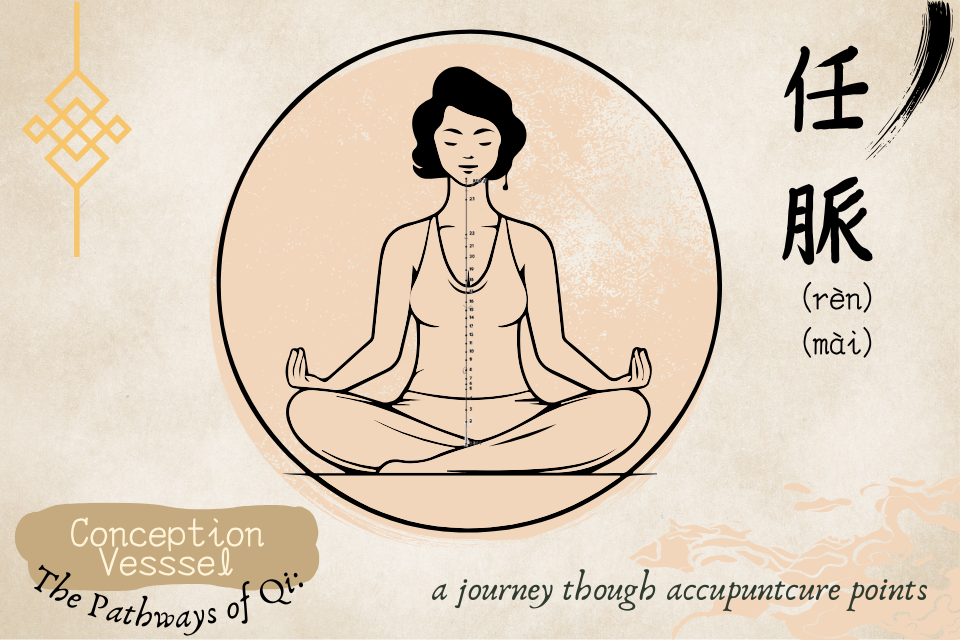
Although the Conception Vessel is well known, it is of great importance to begin by understanding what this main channel itself represents. When we know the meaning of the vessel, our grasp of each point becomes deeper and more precise. For instance, Ren Mai is not simply a line across the body: it is the Sea of Yin itself — a current of nourishment, receptivity, and creation.
When we know the essence of the channel, the meaning of each point deepens: its qualities are not random but shaped by the vessel it belongs to.
Ren Mai is Yin, every point along its course is touched by Yin’s color, even when certain points lean toward Yang expression. It is as if the whole river dyes each stone it carries with its waters.
This underlying nature colors, unifies the pathway, allowing us to appreciate each point not only in isolation but as part of a larger current of meaning.
任脈 (Rèn Mài) — The Conception Vessel
任 (Rèn): The character 任 signifies "to bear, to carry responsibility, to entrust." It combines the person radical (亻) with the phonetic 壬, symbolizing the body's duty to nourish and sustain. In the Conception Vessel, it evokes the profound task of carrying life, whether in the womb, in the blood, or in the hidden spark of ideas yet to be born.
脈 (Mài): The character 脈 means "vessel, meridian, pulse." It combines 月 (flesh) with 永 (eternal flow), representing circulation that never ceases, the endless river of life within us.
Together —
任脈 (Rèn Mài): The Conception Vessel is called the "Sea of Yin," the channel that governs fertility, creation, and nourishment. More than a pathway, it is a living metaphor for the body's capacity to hold, sustain, and bring forth new beginnings.
Spiritual Symbolism: The Ren Mai embodies Yin — receptive, grounding, life-giving. It stabilizes Yang by containing it and is most influential in reproduction and childbirth. It is the vessel of beginnings, carrying the possibility of renewal in every cycle.
CV6 Qìhǎi — 氣海 (Sea of Qi)
Name & Imagery
CV6, Qìhǎi — “Sea of Qi,” evokes a vast inner ocean where life-force gathers and flows. Just as the sea contains depth, mystery, and power, this point represents the reservoir of Qi in the lower abdomen. It is seen as a central wellspring of vitality, the hidden ocean that nourishes every channel. Daoist practitioners visualized it as a glowing pool beneath the navel, where breath becomes energy and energy becomes life.
Location
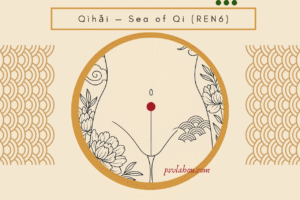
CV6 is located on the anterior midline of the lower abdomen, 1.5 cun below the umbilicus and 0.5 cun above CV5 (Shimen). It lies in the very heart of the lower jiao, close to the region known as the lower dantian in Daoist alchemy — the energetic center of gravity, grounding, and inner cultivation.
Classical Functions
In classical Chinese medicine, CV6 is one of the great points for strengthening primal Qi and supporting the body’s foundation. It tonifies original Qi (yuan qi), nourishes Kidney essence, and consolidates the lower jiao. It has been described as extending life, preventing exhaustion, and restoring vitality when depleted.
In short:
Tonifies Qi and Yang
Strengthens original Qi and consolidates essence
Regulates menstruation and alleviates pain
Rescues collapse of Yang in emergencies
Qìhǎi REN-6 is considered one of the most important points for cultivating health and longevity, sometimes called the “Sea of the 12 Channels.” Its role extends beyond one organ system — it replenishes the very energy that sustains them all.
Modern Context
In modern practice, CV6 is often used to support energy levels, fertility, and digestion, as well as to strengthen immunity and resilience. It is also a key point in qigong and meditation, where awareness of the lower abdomen is cultivated to anchor the mind and breathe life into the body. Gentle acupressure or mindful breathing at this point awakens calmness, grounded strength, and vitality.
Symbolism and Cross-Cultural Echoes
CV6 resonates closely with the lower dantian of Daoist inner alchemy, the cauldron where breath and essence transform into life-force. In Indian traditions, it aligns with the Svadhisthana (sacral) chakra but also touches aspects of Manipura (solar plexus chakra), as it links energy, vitality, and creative flow. Both traditions highlight this region as the furnace of life, where energy is stored and distributed. Symbolically, the “Sea of Qi” is a reminder that within each of us lies an inexhaustible reservoir of strength, waiting to be remembered and cultivated.
Point Combinations
CV6 is often paired with CV4 (Guanyuan) to tonify essence and Qi, and with ST36 (Zusanli) to strengthen overall vitality. It may also be combined with KI3 (Taixi) to harmonize Kidney Qi, creating a powerful formula for grounding and renewal. Such pairings balance the ocean of Qi with the springs of nourishment, amplifying both clinical effect and symbolic depth.
Gentle Practice for Self-Care
To honor CV6, one can rest a hand on the lower abdomen, breathe slowly, and imagine each inhale filling an inner ocean with light. In qigong, focusing attention here steadies the spirit and cultivates inner strength. A simple practice: as you breathe, let awareness sink to this point, visualizing a glowing sea expanding and contracting with each breath.
Reflection
How do I replenish my inner sea of energy? What practices or choices allow me to feel deeply nourished, steady, and alive?
*Yuan Qi (元氣) — Original Qi
Yuan Qi, often translated as Original Qi, is considered the body’s most fundamental energy. It is derived from the union of parental essence at conception and nourished throughout life by the Kidneys. Yuan Qi circulates via the Sanjiao (Triple Burner), animating every organ and function. It is the hidden flame behind breath and movement, the wellspring of vitality that allows us to grow, adapt, and heal. When Yuan Qi is strong, the body thrives with resilience; when it is weak, fatigue, premature aging, or chronic imbalance may follow. Cultivating Yuan Qi — through rest, nourishment, and breath — is seen as one of the surest ways to extend both health and life.
*Lower Dantian (下丹田)
The lower dantian, located in the region of the lower abdomen (close to CV6 and CV4), is a central concept in Daoist inner alchemy, qigong, and martial arts. The word dantian means “elixir field,” a place where subtle energies are refined. The lower dantian is the body’s energetic center of gravity — the root of vitality, stability, and inner strength. In practice, focusing awareness here while breathing cultivates calm, consolidates Qi, and anchors the mind in the body. Like the Sea of Qi itself, the lower dantian is regarded as the body’s inner reservoir: a hidden ocean where energy is stored, renewed, and transformed.
References
GB/T 12346-2021. Nomenclature and Location of Acupoints. Standardization Administration of China.
Huangdi Neijing (Yellow Emperor’s Inner Classic). c. 2nd century BCE.
Wiseman, N., & Ellis, A. Fundamentals of Chinese Medicine. Paradigm Publications, 1995.
Kaptchuk, T. J. The Web That Has No Weaver: Understanding Chinese Medicine. McGraw-Hill, 2000.
- Yang, Jwing-Ming. The Root of Chinese Qigong: Secrets of Health, Longevity, & Enlightenment. YMAA Publications, 1989.
Panagiota Sophia Vlahou
Certified Beekeeper | Specializing in Traditional Beekeeping & Natural Wellness Methods
Trained in Traditional Acupuncture – Academy of Traditional & Chinese Medicine
Member of the Beekeepers’ Association of Attica-Greece
Disclaimer: This article is for educational and informational purposes only. It is not intended to diagnose, treat, cure, or prevent any disease, and it does not substitute professional medical advice. Always consult a qualified healthcare professional before making any changes to your diet, lifestyle, or health practices.