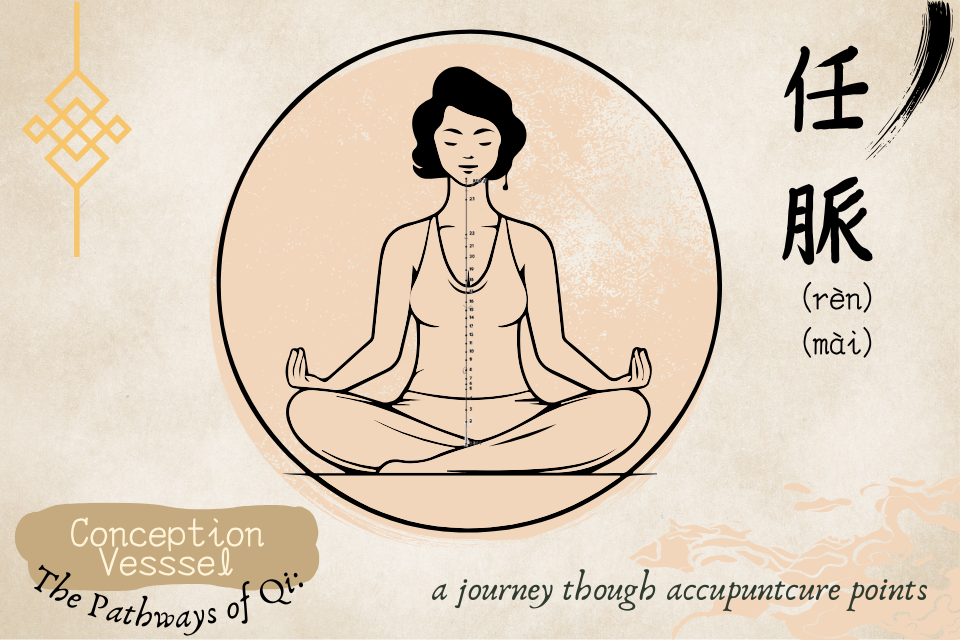
The pathways of Qi: Ren Mai — CV10 Xiawan
Although the Conception Vessel is well known, it is of great importance to begin by understanding what this main channel itself represents. When we know the meaning of the vessel, our grasp of each point becomes deeper and more precise.
Ren Mai is not simply a line across the body: it is the Sea of Yin itself — a current of nourishment, receptivity, and creation.
When we know the essence of the channel, the meaning of each point deepens: its qualities are not random but shaped by the vessel it belongs to.
Ren Mai is Yin, every point along its course is touched by Yin’s color, even when certain points lean toward Yang expression. It is as if the whole river dyes each stone it carries with its waters. This underlying nature colors, unifies the pathway, allowing us to appreciate each point not only in isolation but as part of a larger current of meaning.
任脈 (Rèn Mài) — The Conception Vessel
任 (Rèn): The character 任 signifies “to bear, to carry responsibility, to entrust.” It combines the person radical (亻) with the phonetic 壬, symbolizing the body’s duty to nourish and sustain. In the Conception Vessel, it evokes the profound task of carrying life, whether in the womb, in the blood, or in the hidden spark of ideas yet to be born.
脈 (Mài): The character 脈 means “vessel, meridian, pulse.” It combines 月 (flesh) with 永 (eternal flow), representing circulation that never ceases, the endless river of life within us.
Together — 任脈 (Rèn Mài): The Conception Vessel is called the “Sea of Yin,” the channel that governs fertility, creation, and nourishment. More than a pathway, it is a living metaphor for the body’s capacity to hold, sustain, and bring forth new beginnings.
Spiritual Symbolism: The Ren Mai embodies Yin — receptive, grounding, life‐giving. It stabilizes Yang by containing it and is most influential in reproduction and childbirth. It is the vessel of beginnings, carrying the possibility of renewal in every cycle.
CV10 Xiawan — 下脘 (“Lower Epigastrium” / “Lower Cavity”)
Name & Imagery
CV10, Xiawan — “Lower Epigastrium” or “Lower Cavity” — is the point of digestion’s turning. If CV8 (Shénquè) is the gate of origin, and CV9 (Shuǐfēn) the gate of fluid sorting, then Xiawan is the lower chamber where nourishment is received and transformed. It lies in the region of the epigastrium, just above the solar plexus area, and symbolically it is the hearth where the raw material of life is refined.
In classical texts, Xiawan is described as “the lower curvature of the Stomach”, the channel’s chamber of transformation before nourishment descends deeper. Symbolically, it represents the wisdom of reception and transformation: the body quietly digesting experience, not only food but also the impressions of life. It is the forge of assimilation.
Stomach and epigastrium in Chinese medicine are associated with receiving and letting go, digestion and transformation — and Xiawan anchors the Conception Vessel’s flow into the realm of nourishment and metabolic movement.
Location
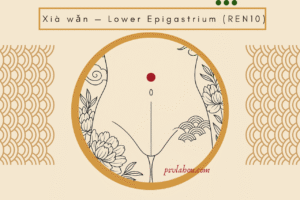
CV10 is located 2 cun above the centre of the umbilicus, on the anterior midline of the abdomen.
Because of its role in digestion and relation to the Stomach region, it is often needled gently and with awareness of the upper abdominal space. Some texts caution deeper needling due to proximity to organs.
Classical Functions
In the classics, Xiawan is known for its ability to harmonise the Stomach and regulate Qi, eliminate food stagnation, and assist the downward movement of Qi.
When nourishment is stuck — as in bloating, indigestion, nausea after eating, epigastric distension — Xiawan acts as the pivot point helping digestion to resume its flow.
In short:
Harmonises the Stomach and regulates Qi
Dispels food stagnation and digestive blockage
Relieves epigastric fullness, nausea, belching
Supports downward movement of rebellious Qi
Modern Context
Today, CV10 is used in clinical practice for digestive dysfunctions — such as gastric stagnation, bloating, nausea, indigestion, even functional gastrointestinal disorders.
In somatic and qigong practice, awareness at Xiawan invites one to observe the process of assimilation: how we take in life’s experiences, how we digest, how we let go or let descend that which no longer serves. It becomes both physical and metaphorical: the body’s digestion of impressions and emotions, not just food.
Symbolism and Cross-Cultural Echoes
In Chinese medicine, the epigastric region is the meeting place of Heaven (above) and Earth (below) in the body’s centre — and Xiawan, at that meeting point, is the crucible of life’s nourishment. In Indian yogic tradition, this area corresponds somewhat to the Manipūra Chakra, the solar plexus centre where our will and transformation meet nourishment.
In Western traditions, the dining hearth or communal table is the place of assimilation, belongs, transformation — where raw resources of life become the body of the family or the body of self. Xiawan, too, is that hearth in the body.
Point Combinations
In classical practice, CV10 is often combined with:
ST36 (Zusanli) to bolster digestion and clear stagnation
CV12 (Zhongwan) to harmonise the middle burner and unify Stomach/Spleen function
SP4 (Gongsun) + PC6 (Neiguan) to support movement of stomach qi and relieve nausea
Symbolically, these combinations link Xiawan’s transformational role with points that either strengthen the digestive furnace (ST36), regulate the epicentre of the body (CV12), or assist the circulation of impressions (SP4/PC6).
Gentle Practice for Self-Care
To honour Xiawan, rest your palms gently above the epigastric area (roughly two finger-breadths above the navel) and breathe slowly into the region, envisioning warmth and motion that turn nourishment into vitality. With each inhale feel the space expand; with each exhale, feel the release of what must descend.
A gentle abdominal massage around the area, moving clockwise, aids digestion and invites the body to integrate and move what is stagnant. A warm compress here, or mindful attention during meal-time (seeing the body receive, digest, transform), can deepen awareness of this transformation hearth.
Reflection
What am I taking in that needs transformation?
Where in my life is nourishment stalled and needs the gentle heat of assimilation?
Xiawan invites us to consider not only the physical digestion of food but the inner digestion of being — to turn raw life into cultivated vitality, to let what no longer serves descend with grace.
References
Moon H, et al., “Acupuncture treatment for functional gastrointestinal disorders”, PMC.
GB/T 12346-2021. Nomenclature and Location of Acupoints. Standardization Administration of China.
Huangdi Neijing (Yellow Emperor’s Inner Classic). c. 2nd century BCE.
Wiseman, N., & Ellis, A. Fundamentals of Chinese Medicine. Paradigm Publications, 1995.
Kaptchuk, T. J. The Web That Has No Weaver: Understanding Chinese Medicine. McGraw-Hill, 2000.