Is there a Solution on Pain Relief ?
Lower back pain, also known as lumbago or lumbar pain, is one of the most common ailments of modern life.
It often appears suddenly — after exposure to cold air, lifting weight, emotional tension, or poor posture — and sometimes as a combination of all these factors.
But beyond its physical causes, emotional and energetic factors also play a crucial role.
In this article, you’ll discover what causes lower back pain, how Traditional Chinese Medicine (TCM) understands and treats it, and how you can relieve it naturally and holistically.
Why Does Lower Back Pain Occur?
Acute lumbar pain or lower back tension often appears with stiffness, burning, or a “locked” sensation.
Common causes include:
Muscle spasm or overuse
Poor posture (especially from prolonged sitting)
Sudden movement or lifting
Exposure to cold or drafts
Emotional strain and fear — when we “carry the weight of the world” on our back
The TCM View: Cold Invasion and Qi Stagnation
In Traditional Chinese Medicine (TCM), lumbago is often linked to Invasion of Pathogenic Cold (Han) or Dampness (Shi) affecting the Kidney and Bladder Meridians — and sometimes also the Ren Mai (Conception Vessel) & Du Mai (Governor Vessel).
When “Cold” penetrates the body, it contracts and blocks the free flow of Qi (vital energy) and Blood, leading to pain, heaviness, and stiffness in the lower back.
Key meridians involved:
Bladder Meridian (Taiyang)
Kidney Meridian (Shaoyin)
Du Mai (Governor Vessel)
- Ren Mai (Conception Vessel)
According to classical theory, Cold constricts the tissues and creates stagnation — much like a frozen river that stops flowing.
The Emotional Connection
The lumbar area represents support, stability, and life force.
When someone feels overburdened by responsibilities, insecure, or unsupported, lower back pain may arise as the body’s way of expressing emotional weight.
In psychosomatic language, we literally “bend under the weight” of life.
Trigger Points and Muscular Tension
Trigger points are small, hypersensitive knots within muscles that cause referred pain elsewhere in the body.
In lumbago, key trigger points include:
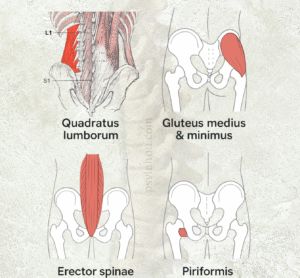
Quadratus lumborum
Gluteus medius & minimus
Erector spinae
Piriformis
When pressed, these points often reproduce pain radiating to the lower back, hips, or legs.
You can stimulate these areas with gentle acupressure, localized heat, or massage balls to release muscle tension.
Auriculotherapy: Ear Points for Lower Back Pain
The ear is a microsystem of the entire body.
For lower back pain, specific auricular points are often used:
Lumbar Spine Point – corresponds to the lumbar vertebrae.
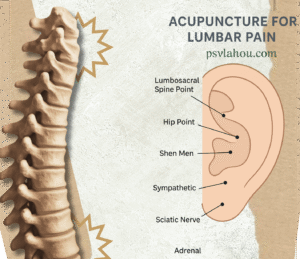
Sciatic Nerve Point – useful when pain radiates downward.
Shen Men – calms the mind and relieves stress-related pain.
Sympathetic Point – balances the autonomic nervous system and reduces spasm.
Adrenal Point – supports energy and reduces inflammation.
Hip Point – used when pelvic tension accompanies lower back pain.
In clinical auriculotherapy, practitioners often use the contralateral ear (the opposite side of the pain), especially in one-sided cases.
Can You Stimulate The Trigger Points Without Needles?
Absolutely. You can benefit from non-invasive auriculotherapy methods such as:
Ear seeds (Vaccaria seeds or metallic beads) applied to the above points.
Gentle massage or pressure for 1–2 minutes per point, two to three times daily.
Local heat therapy (e.g., warm compresses) on the lower back or gluteal trigger points.
Essential oils like wintergreen, marjoram, or black pepper for deep muscle relaxation.
Natural & Holistic Remedies for Lumbago
Bioresonance
Uses mild electromagnetic frequencies to detect and rebalance energetic disharmonies, supporting the body’s natural self-regulation.
Acupuncture & Auriculotherapy
Stimulates specific points on the body and ear to restore the flow of Qi, ease muscle spasm, and relieve pain.
Massage with Essential Oils
Combines gentle pressure with warming or relaxing oils such as lavender, rosemary, or black pepper, improving circulation and releasing tension.
Herbal Tinctures (e.g., Valerian, Harpagophytum, Arnica)
Natural extracts with antispasmodic and anti-inflammatory action that reduce stiffness and pain.
Stretching & Qi Gong
Gentle movements and breathing exercises that restore spinal flexibility and strengthen vital energy (Qi).
Heat Therapy
Warmth is preferred over ice — it disperses Cold, relaxes tight muscles, and restores circulation to stagnant areas.
Kidney Energy Tonification
In TCM, the Kidneys govern the vital essence (Jing).
Strengthening Kidney energy reinforces the body’s root, increasing resilience and reducing chronic lower back pain.
Final Thoughts
Lumbar pain is not merely a mechanical issue — it is often a call for energetic and emotional thawing.
Gentle heat, mindful movement, relaxation, and natural therapies can help restore the flow of life force and bring deep, lasting relief to the lower back.
References
Panagiota Sofia Vlachou
Integrative Wellness Practitioner
Trained in Traditional Acupuncture & Natural Healing Methods
Member of the Beekeepers’ Association of Attica – Greece
Legal Disclaimer
The content of this article and website is for educational and informational purposes only. References to natural therapies s are based on traditional and empirical approaches. They are not medical treatments and do not replace professional medical advice. All services are provided complementarily, with respect for modern medicine and individual responsibility for health.